
- September 3, 2026
- 0 Comments
Learn How to Make the Best Use of Your Knowledge
How to Use Knowledge Effectively
Knowledge is one of the most valuable assets a person can have. We gain knowledge from education, books, work, personal experiences, conversations, and the situations we face throughout life. However, simply having knowledge is not enough. The real value of knowledge comes when we learn how to use it effectively in our daily life.
Many people know a lot about different subjects, but they struggle to apply what they know when they actually need it. This is because collecting information and using information are two different things. A person may have excellent knowledge but still make poor decisions if they do not know how to apply that knowledge in the right situation.
Learning to organize, understand, and apply your knowledge can improve your decision-making ability, confidence, personality, and overall quality of life.
Why Is It Important to Use Your Knowledge Properly?
Everyone has knowledge in some form. You may have knowledge related to your profession, education, business, relationships, health, technology, or everyday life. But knowledge becomes truly useful only when it helps you solve problems and make better decisions.
For example, knowing that time is valuable is knowledge. But actually managing your time properly is the application of that knowledge.
Similarly, knowing that exercise is good for your body is useful information. Following a regular exercise routine is how you put that knowledge into practice.
Therefore, the goal should not be to collect unlimited information. Instead, focus on learning how to apply your knowledge effectively.
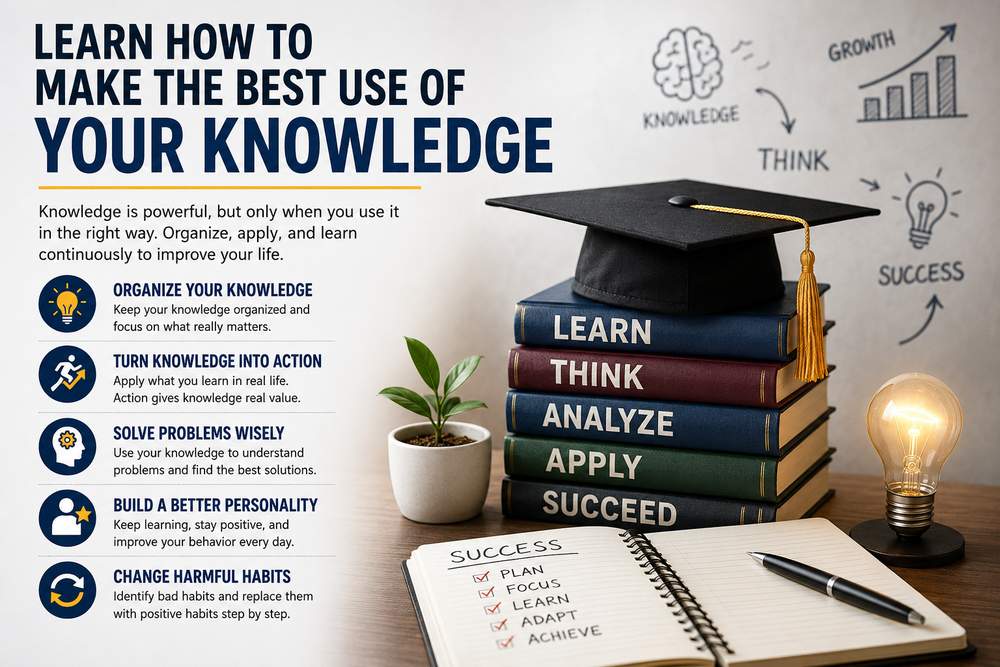
Organize Your Knowledge
One of the first steps toward making better use of your knowledge is to organize it.
Today, we receive enormous amounts of information through the internet, social media, television, books, and conversations. If we do not organize this information, it can become confusing and difficult to use.
Start by identifying the areas that are important to you. Separate useful information from information that has little practical value.
You can maintain notes, make lists, write down important ideas, or keep a journal. When your knowledge is organized, it becomes easier to remember and use when required.
Try asking yourself:
- What have I learned?
- How can I use this information?
- Where can this knowledge help me?
- Is this information still relevant?
- Can I use it to solve a current problem?
These simple questions can help turn scattered information into useful knowledge.
Turn Knowledge Into Action
Knowledge without action has limited value.
You can read hundreds of books about personal development, but your life will not change unless you apply the lessons you learn. You can watch countless videos about productivity, but you will become productive only when you change your daily habits.
This is why action is an important part of learning.
Whenever you learn something useful, try to apply it as soon as possible. Start with small steps instead of waiting for the perfect opportunity.
For example, if you learn a new technique for managing your time, try using it for one week. If you learn a communication skill, practice it in your conversations. If you learn something related to your profession, try applying it to your work.
The practical use of knowledge is what creates real improvement.
Use Your Knowledge to Solve Problems
Life constantly presents us with different challenges. Some problems are related to work, while others may involve money, relationships, education, business, or personal goals.
Instead of becoming overwhelmed by a problem, use your knowledge to understand it.
First, identify the actual problem. Then collect the relevant information and consider possible solutions.
Ask yourself:
What is causing this problem?
What options do I have?
What have I learned from similar situations?
What information do I need before making a decision?
When you approach a problem logically, you are less likely to make decisions based purely on fear or emotion.
Learn to Give Your Worries the Right Direction
Stress and worry are natural parts of life. Everyone experiences moments when they feel uncertain about the future. However, continuously thinking about a problem without looking for a solution can increase stress.
Instead of repeatedly asking, “What will happen?”, try asking, “What can I do about it?”
This small change in thinking can make a significant difference.
For example, if you are worried about your career, identify the skills you need to improve. If you are worried about your finances, review your expenses and look for ways to increase your income. If you are worried about a particular situation, identify the actions that are actually within your control.
You cannot control every situation, but you can control how you respond to it.
Develop Better Decision-Making Skills
Good decisions are usually based on a combination of knowledge, experience, observation, and careful thinking.
Before making an important decision, avoid rushing. Collect the necessary information and consider the possible consequences.
Think about both the short-term and long-term effects of your decision.
You can also learn from other people’s experiences. Reading biographies, studying successful people, and understanding past mistakes can provide valuable lessons.
However, remember that every situation is different. Do not blindly copy someone else’s decision. Instead, use their experience as a source of information and make your own judgment.
How to Build a Better Personality
A strong personality is not created only by appearance, clothing, or communication style. A person’s personality is also influenced by their thinking, knowledge, behavior, confidence, and ability to handle difficult situations.
A person who continues learning and applies that learning in everyday life gradually develops greater confidence.
To improve your personality:
- Keep learning new things.
- Listen carefully to other people.
- Think before you speak.
- Learn from your mistakes.
- Accept constructive criticism.
- Avoid unnecessary arguments.
- Develop positive habits.
- Improve your communication skills.
- Take responsibility for your decisions.
- Stay open to learning.
These habits can help you become more mature, confident, and balanced.
Change Harmful Habits and Behavior
Sometimes the biggest obstacle to personal growth is not a lack of knowledge but harmful habits.
You may already know what is good for you, but changing your behavior can still be difficult. This happens because habits develop through repetition over time.
The first step is to identify the behavior you want to change. Then try to understand when and why it occurs.
Instead of trying to change everything at once, focus on one habit at a time.
Set small and realistic goals. If you fail on one day, do not give up. Start again the next day.
For example, if you want to reduce excessive phone use, start by limiting your screen time for a specific period each day. If you want to become more productive, begin with one important task each morning.
Small improvements repeated consistently can eventually create major changes.
Keep Learning From Your Experiences
Experience is another important source of knowledge.
Every success and failure can teach you something. Instead of considering failure only as a negative experience, try to understand what it can teach you.
After completing an important task, ask yourself:
What went well?
What went wrong?
What could I have done differently?
What should I remember for the future?
This habit of self-reflection can help you learn faster and make better decisions in the future.
Final Thoughts
Knowledge can change your life, but only when you know how to use it.
Do not focus only on collecting information. Learn how to organize your knowledge, apply it to real-life situations, solve problems, make better decisions, and improve your behavior.
A knowledgeable person is not necessarily the person who knows everything. A truly wise person understands what information is useful, knows when to use it, and learns from every experience.
Remember:
Knowledge gives you information, but action gives that knowledge value.
Start using what you already know. Learn from your experiences, improve your habits, think carefully before making decisions, and continue developing yourself every day. Over time, these small changes can help you build greater confidence, a stronger personality, and a more successful and meaningful life.